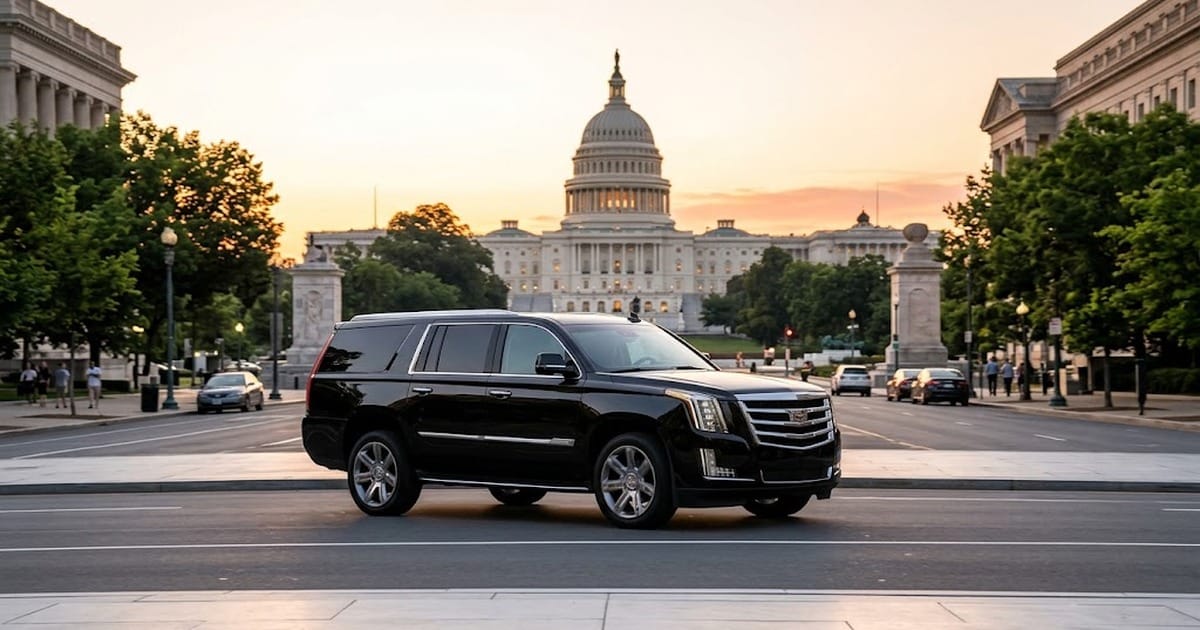
Getting Around DC, Maryland & Virginia: A Traveler’s Guide
Washington DC is a strange city to move through. It’s dense enough that a two-mile trip can eat forty-five minutes in traffic, spread out enough across DC, Maryland, and Virginia that “downtown” means something different depending on which side of the river you’re on, and busy enough — with three major airports, a packed convention calendar, and a constant stream of government, embassy, and corporate travel — that ground transportation here works differently than it does in most cities.
If you’re planning a trip into the DMV (DC, Maryland, Virginia) for business, a family visit, or a special occasion, here’s what you actually need to know about getting around.
The Three-Airport Question
Most cities have one main airport. The DMV has three, and picking the right one — or knowing which one you’re stuck with — changes your entire transportation plan.
- Ronald Reagan Washington National (DCA) sits just across the Potomac from downtown DC, a few miles from the Capitol and the National Mall. It’s the closest airport to the city center by far, which makes it the default for a lot of domestic business travel, but it also means it’s tightly regulated with fewer long-haul and international routes.
- Washington Dulles International (IAD) is out in Loudoun County, Virginia, roughly 25 miles from downtown. It handles the bulk of international arrivals and long-haul flights, which means more travelers landing here are dealing with jet lag, customs, and unfamiliar territory all at once.
- Baltimore/Washington International (BWI) sits north of DC in Maryland, closer to Baltimore than to the capital, but often cheaper to fly into and a reasonable option depending on where in the region you’re actually headed.
The practical takeaway: know your airport before you plan the rest of the trip. A DCA arrival for a downtown meeting is a short, predictable ride. An IAD arrival after an overnight international flight, or a BWI arrival when your final destination is actually in Northern Virginia, is a longer trip where a pre-arranged ride matters a lot more than it would in a smaller city.
Ground Transportation Options in the DMV
Rideshare (Uber/Lyft)
Widely available and usually the cheapest option for short, casual trips. The catch in DC specifically: pricing swings hard during rush hour, bad weather, and the near-constant calendar of protests, motorcades, and street closures that can turn a normal route into a 40-minute detour with no warning.
Metro and Public Transit
DC’s Metro system is genuinely useful if you’re staying near a station and traveling light, and it connects reasonably well to DCA. It’s far less practical from IAD or BWI, or if you’re carrying luggage, traveling with a group, or trying to make a specific appointment time.
Taxis
Still around, still metered, still a fallback option — but increasingly rare outside of a few pickup zones, and not something you can count on being available curbside the way you might in other major cities.
Traditional Limousine Service
Stretch limousines and the classic “limo” experience are generally reserved for events — weddings, proms, milestone celebrations — rather than day-to-day or business travel. It’s priced by the hour and built around groups traveling together as part of the occasion itself.
Black Car / Executive Chauffeur Service
This is where most business travelers, government and embassy staff, and anyone with a fixed schedule tend to land. Black car service uses professional sedans or SUVs, pre-booked with a dedicated chauffeur, typically at a flat rate rather than metered or surge pricing. It’s the standard choice for airport transfers, corporate meetings, and any trip where a confirmed pickup time isn’t optional.
Why the DMV Is a Different Kind of Travel Market
A few things make ground transportation in this region genuinely more complicated than in a typical city, and worth planning around:
Motorcades and street closures. Between the White House, Capitol Hill, foreign embassies, and a steady stream of visiting dignitaries, DC deals with unscheduled road closures more than almost any other US city. A route that took fifteen minutes yesterday can be a dead end today.
Three states, three sets of traffic patterns. DC proper, Northern Virginia (Arlington, Alexandria, Fairfax), and suburban Maryland (Bethesda, Silver Spring, Rockville) each have their own rush-hour rhythms, bridge and tunnel bottlenecks, and event calendars. A driver who only knows one side of the river isn’t much help if your day spans all three.
A heavier share of business, government, and embassy travel. Compared to a typical leisure-heavy destination, the DMV sees an unusually high volume of travelers who need discretion, reliability, and professionalism as much as they need a ride — think law firms, federal agencies, embassies, and corporate road warriors, not just tourists.
Event-driven surges. Presidential inaugurations, major protests, cherry blossom season, and a packed convention and conference calendar all create predictable spikes in demand — and predictable spikes in rideshare surge pricing right alongside them.
How to Choose the Right Service for Your Trip
A few questions can narrow this down quickly:
Do you have a hard deadline? A flight to catch, a meeting on the Hill, a court appearance — anything with a fixed time is a strong argument for a pre-booked service with flight tracking and a confirmed pickup, rather than hoping a rideshare driver is nearby when you need one.
Which airport, and how far is your actual destination? A DCA-to-downtown trip is forgiving. An IAD-to-Alexandria trip after an overnight flight, or a BWI arrival for a Northern Virginia meeting, benefits a lot more from a driver who already knows the route and isn’t guessing at traffic patterns across state lines.
Does discretion or professionalism matter for this trip? Government meetings, embassy functions, and executive travel generally call for a different standard of vehicle and driver than a casual weekend visit.
Is the ride part of the occasion, or just how you get there? A wedding party or a milestone celebration is still squarely in traditional limousine territory. A business trip or airport run is a black car conversation.
What to Look for When Booking
Whichever category of service you choose, a few things separate the operators worth booking from the ones that leave you standing at the curb:
- Flight tracking for airport pickups, so a delayed or early arrival doesn’t leave you without a ride or paying extra for it.
- Flat-rate pricing agreed to before you book, rather than a fare that changes based on traffic, weather, or demand that day.
- Professional, vetted chauffeurs rather than an app-based pool of drivers, particularly for anyone traveling with sensitive schedules or clients.
- Local knowledge across all three jurisdictions — DC, Maryland, and Virginia each have their own traffic quirks, and a driver unfamiliar with all three is a liability on a multi-stop day.
- 24/7 availability and a live dispatcher, since flight delays and schedule changes don’t happen on a 9-to-5 clock.
For anyone comparing options, a reliable Washington DC Limo Service is generally the one that treats flat pricing, professional chauffeurs, and real availability as the baseline, not an upsell you have to ask for.
Airport Transfers Deserve Extra Planning
Of all the trips covered here, airport transfers are the ones where a pre-arranged ride pays off the most. Between the three-airport layout, the region’s unpredictable road closures, and the sheer distance some travelers cover getting from an airport to their final stop, a confirmed pickup with flight tracking removes a genuine source of stress that a same-day rideshare simply can’t match.
That’s the core case for booking Washington DC airport transportation in advance rather than sorting it out after you land: a chauffeur who’s already tracking your flight, already knows whether you came into DCA, IAD, or BWI, and is waiting curbside regardless of delays, diversions, or an early landing. For a first-time visitor navigating an unfamiliar city, or a frequent business traveler who just wants one less thing to think about, that certainty is usually worth more than the modest savings of rolling the dice on rideshare.
Final Thoughts
There’s no single right way to get around Washington DC, Maryland, and Virginia — the right call depends on your schedule, your destination, and how much certainty you actually need. Rideshare and Metro work fine for short, flexible, low-stakes trips. Traditional limousine service still owns weddings and celebrations. But for airport transfers, business travel, government and embassy work, or any trip where being on time genuinely matters, a pre-booked black car or executive service is the option experienced DMV travelers tend to default to — and for good reason, given everything from motorcades to three-state traffic patterns working against a loosely planned day.
Whatever you decide, the same advice applies everywhere: book ahead when your schedule allows it, confirm flat-rate pricing before you need it, and ask how the company handles flight delays or last-minute changes before you’re the one standing at the curb wondering where your ride is.